



It seems even OpenAI cannot retain top talent.
Xi Yin, Harvard’s youngest‑ever Chinese full professor, recipient of the Sloan Research Fellowship and New Horizons in Physics Prize, and a star scholar in string theory, has officially announced his departure from OpenAI.
News of his hire first broke at the end of May this year, and barely half a year has passed since he took up the role.
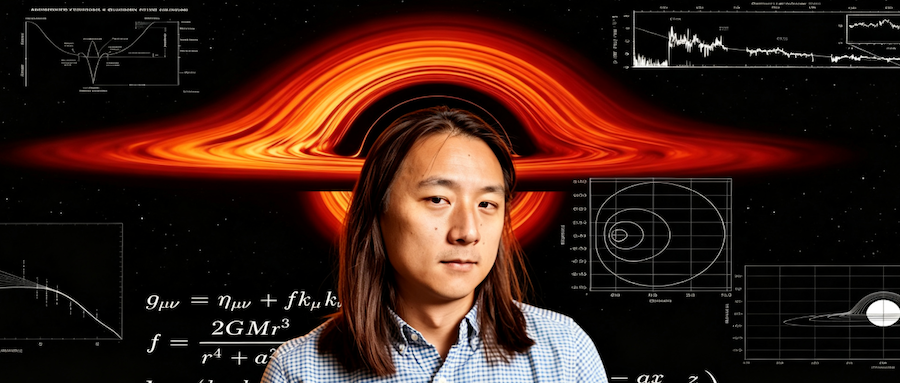
In a post on X (Twitter), he commented on his resignation: “It’s been a fantastic journey, but I’m getting off early to explore new directions.”
Yin also revealed this was his first‑ever industry job. He extended special thanks to Alex Lupsasca and Boris Alexeev for helping him settle into the role, as well as Dan Roberts for his ongoing support. He closed with encouragement for his former colleagues: “I’ll keep rooting for you all!”
Yin has not disclosed his next destination. His faculty profile still appears on Harvard’s Department of Physics website.
It is possible he only took this corporate role as a sabbatical experiment. Some online users have speculated he may join Discovery Loop, an AI startup founded by former Google chief scientist Jeff Dean and other figures.
For now, we will have to wait and see where he lands.
Who Is Xi Yin?
Xi Yin was admitted to the University of Science and Technology of China’s Juvenile Class at age 12. He earned his PhD in physics from Harvard University in 2006. In 2015, at the age of 31, he was promoted to full professor at Harvard, earning him media recognition as Harvard’s youngest‑ever Chinese full professor.
His research focuses on string theory, quantum field theory and quantum gravity. He received the Sloan Research Fellowship in 2013. Together with Simone Giombi, he won the 2017 New Horizons in Physics Prize for work on higher‑spin gravity and its holographic correspondence.
Beyond his extraordinary academic resume, the physicist holds distinct views on artificial intelligence.
In April this year, before news of his OpenAI appointment emerged, Yin told The Harvard Crimson: “I do not believe there exists any human intellectual capability that AI cannot replicate.”
Much of his optimism stems from hands‑on experience using AI. Yin estimates that even with extensive human oversight, AI has accelerated his research‑related coding work by at least 100‑fold. Code produced by AI in weeks would have taken him ten years to write manually.
Research projects once dismissed as unfeasible due to overwhelming workload have now become viable.
In September of this year, academic circles debated what AI means for mathematics. Twenty‑five Fields Medal laureates including Terence Tao released a joint statement. They warned that AI companies treat solving hard mathematical problems as a competitive benchmark: more answers are generated, yet processes for understanding, organizing and preserving these results lag far behind.
Xi Yin publicly pushed back against this stance. He shared mathematician Timothy Nguyen’s response and wrote: “This is one of the most compelling replies I have read in recent days, with which I fully agree.”
Nguyen opened his argument by stating: “These Fields Medalists’ objections to AI will not stand the test of time.”
His core argument is that methods for understanding mathematics have always evolved. From geometric construction and symbolic computation to computer‑assisted proofs, mathematics keeps expanding its toolbox. Validated machine‑generated proofs, even if temporarily beyond individual human comprehension, can serve as building blocks for further research. If AI makes previously intractable problems solvable, humans can simply push exploration further into uncharted territory.
From this perspective, while he is a human physicist, Yin does not insist humans must occupy the center of scientific discovery. He welcomes scenarios where AI arrives at valid solutions first, so long as results can be verified.
Foundational Scientists Join AI Model Companies
When Xi Yin joined OpenAI, many leading minds in mathematics and physics were already on‑board.
Black‑hole physicist Alex Lupsasca, whom Yin thanked in his farewell note, joined OpenAI for Science back in October 2025. Lupsasca stated at the time that the team aims to build AI systems that advance scientific reasoning and accelerate breakthroughs in mathematics and physics.
Another high‑profile hire announced alongside Yin was Weijie Su, counted among the “second‑generation elite” from Peking University’s School of Mathematical Sciences.
In May this year, Su announced he would join OpenAI to work on model training during his sabbatical leave from the Wharton School, where he was concurrently promoted to full professor.
Earlier this year, Lijie Chen, a theoretical computer scientist and alumnus of Tsinghua University’s Yao Class, also joined OpenAI to focus on mathematical reasoning.
Scientists contribute research questions and expertise to evaluate output quality. AI companies supply models, computing power and engineering infrastructure.
The shared objective is straightforward: enable AI to meaningfully participate in scientific discovery.
Yin laid out his take on the relationship between AI and researchers in that April interview: He would be delighted as long as AI can produce verifiable answers. Whether humans conceived those answers is secondary.
Reference [1] https://x.com/XiYin137/status/2117405976462844370



暂无评论内容